


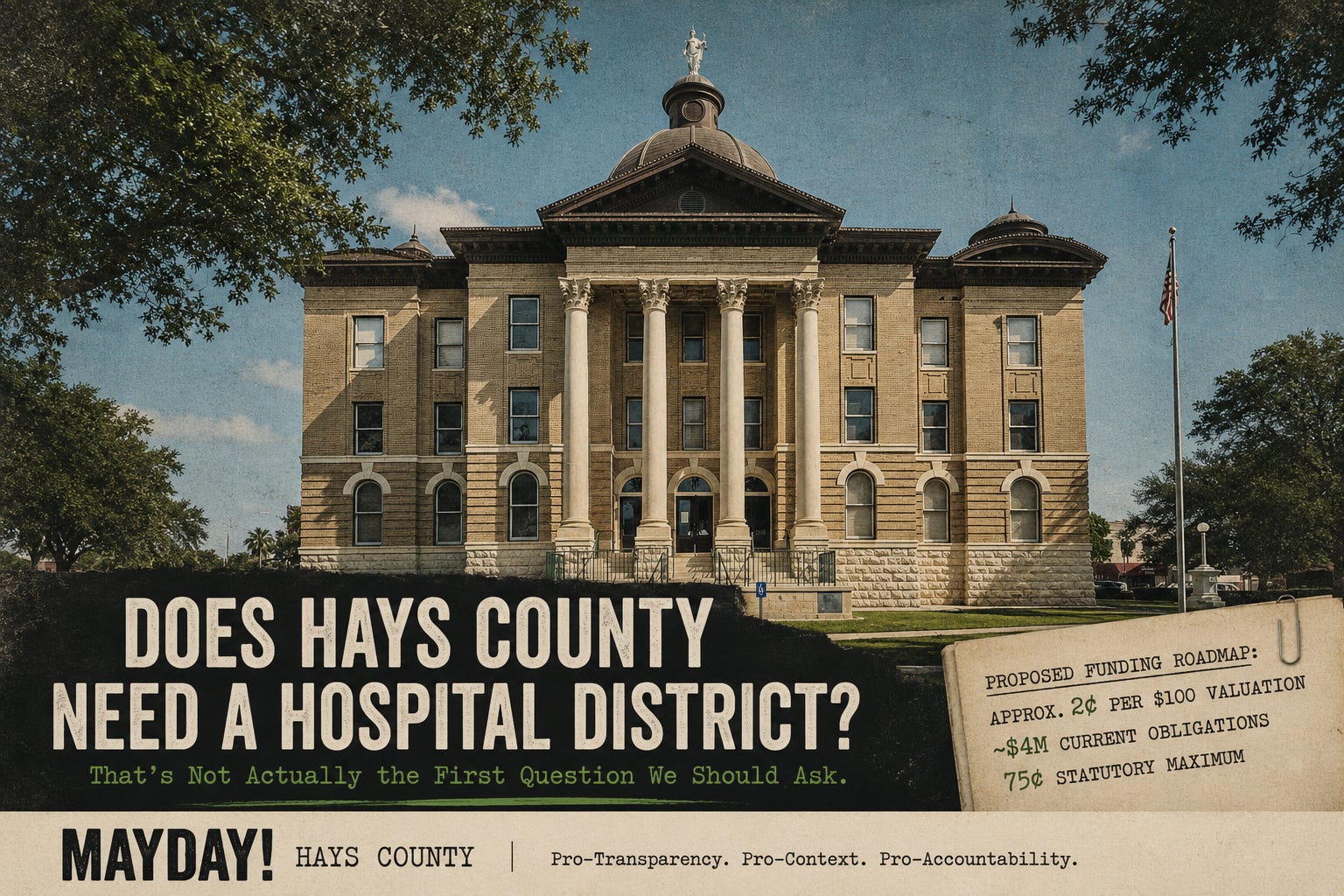
Hays County Judge Ruben Becerra wants voters to create a countywide hospital district.
That proposal has very quickly turned into a political fight about who cares more about poor and working-class people.
Becerra has criticized commissioners who didn’t show up to a special meeting called to advance the petition process. Supporters of his proposal have responded by asking why anyone would stand in the way of expanding healthcare. Opponents have focused on the possibility of another property tax and the speed at which the proposal has been pushed forward.
His August 17 special meeting ultimately failed for lack of a quorum, keeping the proposal off the November ballot. Becerra characterized the commissioners’ absence as thwarting a citizen petition, while Commissioners Debbie Ingalsbe and Michelle Cohen said creating a taxing district of this significance warranted considerably more public discussion first. (See Cohen’s Facebook post and this article quoting Ingalsbe.) Commissioner Walt Smith, also not present, said the process for calling the meeting and the petition itself were invalid.
All of this political posturing aside, we’re skipping a question:
What problem, exactly, are we trying to solve, and what does creating a hospital district allow Hays County to do that it cannot do right now?
Because here’s the first thing everybody needs to understand:
Hays County already provides healthcare.
Texas counties are not sitting on the sidelines of the healthcare system waiting for someone to give them permission to participate.
Under Chapter 61 of the Texas Health & Safety Code, counties are responsible for providing healthcare assistance to certain eligible residents who don’t have another adequate source of payment. Hays County therefore already operates an Indigent Health Care Program.
And the program covers real healthcare. Eligible residents can receive office visits and annual physicals, diagnostic testing and imaging, specialist care following referral, hospitalization, emergency-room care, prescription medications and referrals for mental-health services.
So when we’re talking about whether Hays County should provide healthcare to people who can’t afford it, we’re not actually debating whether county government should enter the healthcare business.
The more useful question is how much healthcare Hays County wants to provide, to whom, and through what structure.
Because our existing program is extraordinarily restrictive.
You have to be very, very poor to qualify in Hays County.
Hays County currently limits its indigent healthcare program to residents with income below 21% of the federal poverty level.
Not 210%.
Not 200%.
Twenty-one percent.
The county also says it pays providers up to $30,000 in eligible expenses per patient per program year, with hospitalization additionally limited to 30 days or $30,000 in eligible expenses, whichever comes first.
That leaves an enormous population between “poor enough to qualify for county assistance” and “financially comfortable enough to absorb the cost of American healthcare.”
And that is exactly the population Becerra keeps talking about when he talks about working people who can’t afford healthcare.
He’s identifying a real problem.
But his framing is that Commissioners Court needs a new hospital district before it can begin addressing it.
It doesn’t.
The state minimum does not have to be Hays County’s maximum.
Chapter 61 explicitly permits a county to use less restrictive eligibility standards than the state’s baseline.
That means Commissioners Court has choices. It could appropriate more of Hays County’s existing revenue to healthcare. It could expand eligibility beyond the extraordinarily low threshold we’re using now.
And Hays County’s existing authority goes considerably further than simply reimbursing indigent hospital bills.
Under Chapter 61, a county can arrange healthcare through public facilities, local health departments or private providers, including providers outside the county. A county can purchase insurance, health coverage or other health benefits for eligible residents. It can also affiliate with public hospitals, hospital districts and other governmental entities to provide and administer healthcare regionally.
In other words, some of the things that sound like reasons Hays County needs a hospital district are things Texas law already allows the county to do.
That does NOT mean Commissioners Court can recreate everything a hospital district can do simply by spending more money. It can’t.
But it does mean the existing county model is more flexible than the phrase “indigent healthcare program” might suggest.
Hays County can make more residents eligible and build a more robust local healthcare program NOW. Changing the eligibility requirements could mean more people qualifying. More funding from the existing budget could mean more healthcare being covered, more providers participating and a much more ambitious healthcare-access program than the one Hays County operates today.
There are limits to what can be accomplished within the existing structure. Chapter 61 isn’t a blank check allowing Commissioners Court to invent any healthcare system it wants. Eligibility, reimbursement and state-assistance rules still matter.
But the important point is this:
Ruben Becerra’s hands are not tied.
Neither are the commissioners’.
If Commissioners Court believes Hays County’s existing healthcare safety net is failing working people, it already possesses meaningful authority to make that safety net bigger. Commissioners can debate eligibility and spending now. They can ask what it would cost to serve more people and decide healthcare deserves a larger share of the existing county budget.
None of that requires pretending the only two choices available to us are:
Create a hospital district → people get healthcare
or
Don’t create one → people don’t.
After looking at what hospital districts elsewhere in Texas actually do, though, I don’t think the hospital district itself is necessarily a bad idea.
In fact, I think it’s a very good one.
Thirty miles north of us is the argument Becerra should be making.
Travis County has a hospital district.
If you want to understand why Hays County might eventually decide to create one, don’t start with political slogans. Start there.
Central Health operates the Medical Access Program, or MAP, and MAP Basic for uninsured Travis County residents with low incomes.
Today, uninsured Travis County residents with incomes at or below 200% of the federal poverty level can qualify for MAP or MAP Basic if they meet the other eligibility requirements.
For FY2026, 200% FPL works out to about $2,660 a month for one person and $5,500 a month for a family of four.
Compare that with Hays County’s 21% FPL threshold.
Using the 2026 federal poverty guidelines, that’s roughly $279 a month for one person, or $578 a month for an entire family of four.
That’s how poor you currently have to be to qualify for Hays County’s indigent healthcare program.
That’s not a small difference in administrative policy. It’s a fundamentally different concept of who the local healthcare safety net should serve and what that safety net should look like.
MAP members can access doctors, specialists, pharmacies, dental care and other healthcare services through a network built around the district. Central Health reports that its broader system supported more than 200,000 residents through MAP, MAP Basic and related coverage in 2025.
That starts looking less like an indigent reimbursement program and more like an actual local healthcare system.
And MAP isn’t health insurance. Central Health is explicit about that.
It is locally funded health coverage that connects eligible residents to a network. That matters because one of the easiest ways to misunderstand this debate is to imagine that creating a hospital district means Hays County starts handing uninsured residents Blue Cross cards.
That’s not what we’re talking about.
We’re talking about how to build a local system for getting people healthcare.
So what does a hospital district actually change?
A hospital district doesn’t suddenly unlock every healthcare tool Hays County currently lacks.
In fact, Chapter 61 already gives the county many of those tools.
The fundamental difference is structural.
Right now, healthcare assistance exists within the county budget. Commissioners Court sets the eligibility requirements, and healthcare competes for county resources alongside roads, law enforcement, courts, parks, emergency services, employees and everything else the county funds.
A hospital district changes that structure.
Instead of healthcare being one responsibility of county government, you create a political subdivision whose entire job is healthcare, with its own governance, budget, long-term planning and, critically, dedicated tax base.
So we’re not really asking:
“Does Hays County have the legal authority to do more?”
It does.
The real hypothesis behind a hospital district is that Hays County could provide more healthcare, more consistently and at greater scale, if healthcare had its own institution and governmental lane.
Chapter 61 already provides considerable authority over eligibility and healthcare obligations. A hospital district creates an enduring institution of local government with revenue dedicated specifically to that mission.
But somebody has to pay for that institution.
A hospital district is not free money.
Under Chapter 286, the proposition creating a property-tax-supported hospital district authorizes an annual property tax, with the rate stated in the petition and capped by statute at 75 cents per $100 of taxable value.
But here’s an important piece of context:
Nobody is actually proposing a 75-cent tax rate.
A proposed resolution circulated by Becerra lays out what it calls an “anticipated funding roadmap” for the Hays County Hospital District.
According to that document, Hays County currently spends approximately $4 million annually on existing indigent-healthcare obligations paid through the county’s general operating budget.
The resolution says current projections indicate those existing obligations could be funded through a hospital-district tax of approximately 1 cent per $100 of taxable property value.
For additional funding, it proposes 2 cents per $100 of taxable property value overall.
According to the resolution, that additional capacity, together with available federal matching funds, could be used to reduce healthcare costs and expand healthcare services available to the community.
That is a much fairer starting point for this conversation than “the district could tax you 75 cents.” But neither the proposal nor this resolution tells us what “reducing costs” or “expanding services” actually means.
It does give us something concrete to interrogate.
If approximately one cent would replace healthcare obligations Hays County says it is already paying from its general operating budget, what happens to the approximately $4 million currently being spent there?
Does it return to the general fund for other county priorities? Does Commissioners Court contemplate reducing some other portion of the county tax burden? Does it simply become additional spending elsewhere?
And then there’s the more important healthcare question:
What exactly does the second cent buy us beyond the extraordinarily narrow safety net we’re currently getting for roughly $4 million?
How many more residents become eligible? How far could the income threshold move? What additional services or provider network could we build, and how much additional state or federal funding would those local dollars actually unlock?
Those aren’t rhetorical objections. They’re the beginnings of a cost-benefit analysis.
For perspective, Travis County’s mature hospital district operates on a dramatically larger scale. Central Health’s approved FY2026 tax rate is approximately 11.8 cents per $100, producing about $460 in hospital-district taxes on its listed median taxable homestead value of roughly $390,000. Its FY2026 budget includes approximately $434 million for healthcare delivery. That’s more than 100 times Hays County’s current $4 million figure.
Nobody should extrapolate Travis County onto Hays County. We aren’t even comparable.
But what should the math for Hays County look like? Where did two cents per $100 come from? What do we get for it?
This is where the current proposal feels backwards.
We’ve spent an enormous amount of time talking about petitions, special meetings, elections, which commissioner showed up, which one didn’t, taxes and Becerra himself.
We haven’t spent nearly enough time talking about the healthcare system.
What would a Hays County hospital district actually look like?
Who would qualify, and at what income threshold? Would we build something resembling Travis County’s MAP program? Would residents have a primary-care medical home? Which hospitals, doctors and clinics would participate?
Would the district cover dental and mental healthcare, specialists, prescriptions, women’s healthcare, transportation or chronic-disease management? Would people pay copays based on income? Could the district arrange or purchase health coverage for some residents?
Most importantly, how many people would it serve, what would it cost, and what specifically would the contemplated two-cent tax rate pay for?
What happens to the approximately $4 million Hays County says it currently spends on healthcare once eligible obligations move from the general fund to the district? How much federal matching money is actually available, through which programs and under what conditions? What would success look like five years after voters created it?
Those aren’t objections to a hospital district.
Those are the questions you answer when you’re serious about creating one. Those are the conversations you bring to the table when you submit a proposal for a framework.
There are really two conversations Hays County should be having simultaneously.
The first is immediate:
Why aren’t we doing more right now?
If our 21% FPL eligibility threshold is leaving people behind, Commissioners Court should examine it. If the program is underfunded, tell us what meaningful expansion would cost. If there aren’t enough participating providers, identify that problem. If residents don’t know the program exists, fix that too.
Becerra doesn’t need to wait for an election to start that work. Neither do the commissioners who oppose or distrust his proposal.
If a commissioner believes Becerra’s approach is wrong, I don’t particularly want to hear only why his proposal is bad.
Show me yours.
Because “Becerra is handling this badly” isn’t a healthcare policy either.
The second conversation is much bigger:
Is Hays County ready to build a permanent local healthcare institution?
That’s where I think the hospital-district proposal deserves serious research rather than reflexive opposition.
Hays County isn’t the county it was twenty years ago. We’re growing, and our healthcare infrastructure has to grow with us.
There is something genuinely compelling about creating an institution whose mandate isn’t roads, jails, tax abatements, development agreements or whatever political fight Commissioners Court is having that week.
Its job would be providing people in Hays County access to healthcare regardless of their ability to pay.
I can see the argument for that. I might even end up championing it.
But not because someone told me poor people need healthcare.
I already know they do.
Show me why a hospital district is the best mechanism for actually providing it when you have tools at your disposal right now that you aren’t using.
We don’t have to wait to do something radical.
Hays County is in the middle of deciding how to spend its money.
Ask your commissioners to examine the 21% FPL eligibility threshold, cost out the expansion, and add it to their budget before they approve it.
The county’s FY2027 budget calendar has the proposed budget headed to an August 25 public hearing at 1 p.m.
That hearing isn’t separate from this healthcare debate. In fact, it’s where this conversation needs to be happening.
Under Chapter 61, Commissioners Court has the authority to adopt less restrictive eligibility standards for Hays County’s existing indigent healthcare program.
Right now, that threshold is less than 21% of the federal poverty level.
So while we’re debating whether Hays County should eventually create an entirely new government dedicated to healthcare, Commissioners Court could be asking a much more relevant question in its budget talks:
What would it cost to stop requiring people to be almost impossibly poor before Hays County helps them get healthcare?
Run the numbers at 50% FPL. Then 100%, 138% and 200%.
How many Hays County residents become eligible at each level? What services could we provide them? Could we contract with more doctors and clinics or purchase health coverage for some eligible residents using authority the county already has under Chapter 61?
What would each option cost, and how does that compare with what Becerra says his proposed hospital district could accomplish with approximately two cents per $100 of taxable value?
Put those options next to each other and let the public see them.
This is also where simply criticizing Becerra stops being enough.
If Commissioners Cohen, Ingalsbe and Smith believe his hospital-district proposal was rushed, underdeveloped or the wrong mechanism, that’s a perfectly legitimate position.
But they have an opportunity RIGHT NOW to show us the alternative.
Commissioners Court already controls an existing healthcare program. It already has authority to make eligibility less restrictive and to appropriate more county revenue to healthcare. And it is making decisions about Hays County’s budget right now.
So use that authority.
Propose something. Put a number on it. Let the public debate it.
Becerra should have to explain exactly what his proposed two-cent hospital district would buy us.
And commissioners who believe we shouldn’t create that district should have to explain what they’re willing to accomplish with the government and money we already have.
Maybe the answer is expanding the existing county program.
Maybe the answer is a hospital district.
Maybe the best answer is doing something meaningful now while we spend the next year designing a hospital district worth voting for.
We don’t need another political fight to figure out where to begin.
We need Commissioners Court to give the public actual choices:
Here is what Hays County can do now and what it would cost.
Here is what a hospital district could do instead and what that would cost.
Then let Hays County decide how ambitious it wants to be.
Sources & Further Reading
Hays County — Current Healthcare Program & Budget
Hays County — Indigent Health Care Program
Hays County’s existing County Indigent Health Care Program, including eligibility requirements, covered services, application information, the current 21% FPL income standard and program limits.
Hays County — Financial Transparency & Budget Process
Explains Hays County’s annual budget process, including August budget workshops and Commissioners Court’s role in determining county spending priorities.
Hays County — FY2027 Amended Budget Calendar
Official timeline for the current FY2027 budget process, including the August 11 and August 18 budget workshops and the August 25 public hearing.
Hays County — Public Notices
Official county public-notice page, including notice of the August 25, 2026 hearing on the proposed FY2027 budget.
Texas Law
Texas Health & Safety Code, Chapter 61 — Indigent Health Care and Treatment Act
Governs county indigent healthcare responsibilities. Particularly relevant are §61.023 on county eligibility standards and §61.029 on counties’ authority to arrange healthcare, purchase insurance or health coverage for eligible residents, and affiliate with other governmental healthcare entities.
Texas Health & Safety Code, Chapter 286 — Hospital Districts
Governs the creation and operation of hospital districts. §286.022 addresses the contents of a creation petition, including the proposed maximum property-tax rate and the statutory ceiling of 75 cents per $100 valuation.
How a Texas Hospital District Can Work — Travis County
Central Health — MAP & MAP Basic
Explains Travis County’s Medical Access Program and MAP Basic, including eligibility up to 200% of the federal poverty level and the healthcare available through the programs.
Central Health — Finance, Budget & Tax Information
Central Health’s budget and property-tax information, useful for understanding the scale and financing of a mature Texas hospital district.
The Hays County Hospital District Proposal & August 17 Meeting
Judge Ruben Becerra — August 17 Special Meeting Announcement
Becerra’s public announcement of the August 17 special Commissioners Court meeting concerning the proposed Hays County hospital district.
Judge Ruben Becerra — Statement Following the Failed Special Meeting
Becerra’s statement criticizing commissioners who did not attend and explaining his characterization of the petition and failed meeting.
Commissioner Walt Smith — Statement on the August 17 Special Meeting
Smith’s statement explaining his absence from the August 17 special meeting, including that he was preparing for the county’s mandatory August 18 budget meeting and raising concerns about the timing and process surrounding the hospital-district proposal.
Community Impact — Lack of quorum keeps potential Hays County health district off the ballot
Contemporary reporting on the August 17 meeting, the lack of a quorum, which members attended, and responses from members of Commissioners Court.
Hays Free Press — Hays County Commissioners Court meeting left without quorum
Local reporting on the failed special meeting, including statements from Becerra and Commissioner Debbie Ingalsbe about the process and proposed district.
Additional Primary Materials Reviewed
Proposed “Resolution Establishing the Anticipated Funding Roadmap for the Proposed Hays County Hospital District.”
The proposed resolution reviewed for this article describes an anticipated planning rate of approximately 2 cents per $100 valuation, with approximately one cent projected to address existing county healthcare obligations and additional capacity intended for expanded healthcare services alongside anticipated federal matching funds. It also states that the 75-cent statutory maximum is not the anticipated or intended rate.

August 17, 2026 Statement from Hays County Judge Ruben Becerra Regarding Affordable Healthcare for Hays County
Issued by Becerra following the failed August 17 special meeting and reviewed by Mayday. Becerra states that the required petition signatures had been gathered and validated, characterizes the absent commissioners’ failure to establish a quorum as preventing the petition from reaching the November ballot, and says he intends to continue pursuing affordable-healthcare proposals in Hays County.

August 17, 2026 Hays County Commissioners Court Special Meeting Notice and Agenda.
The official meeting notice reviewed for this article scheduled the special meeting for 2 p.m. on August 17 and included consideration of the petition and proposed November 3 election for creation of the Hays County Hospital District.

The Mayday Standard
What do we know?
Hays County already operates a County Indigent Health Care Program under Chapter 61 of the Texas Health & Safety Code, with a published eligibility threshold below 21% of the federal poverty level. Texas law allows Commissioners Court to adopt less restrictive eligibility standards and gives counties substantial flexibility in arranging healthcare for eligible residents, including contracting with providers and purchasing health coverage.
A hospital district would create a separate political subdivision dedicated to healthcare with its own governance, budget and potential property-tax revenue. The proposed funding roadmap circulated in connection with the Hays County district contemplates approximately 2¢ per $100 of taxable value, rather than the 75¢ statutory ceiling.
How do we know it?
Hays County’s published program rules and budget materials; Chapters 61 and 286 of the Texas Health & Safety Code; the proposed hospital-district resolution and August 17 special-meeting materials reviewed for this article; public statements from members of Commissioners Court; and published program, budget and tax information from existing Texas hospital districts.
What are we inferring?
Hays County could meaningfully expand healthcare access without first creating a hospital district.
A hospital district, however, could provide something structurally different: a permanent governmental institution dedicated specifically to healthcare with a dedicated source of revenue.
Whether that structure would produce better access, greater efficiency or more healthcare per public dollar in Hays County cannot be determined from the proposal as it currently exists.
What remains unknown?
What healthcare system would the proposed district actually build?
We still don’t have a defined eligibility threshold, projected enrollment, provider network, detailed service package or administrative budget. We don’t know precisely what additional healthcare the proposed second cent of taxation would purchase, what would happen to general-fund dollars currently used for county healthcare obligations, or the source, amount and conditions of the anticipated federal matching funds.
We also don’t yet have a costed comparison showing what Hays County could accomplish by expanding its existing Chapter 61 program instead.
Why does it matter?
Because Hays County residents aren’t choosing between healthcare and no healthcare.
The county already has a healthcare program and legal authority to do considerably more with it. The real policy question is whether residents are better served by expanding that existing system through Commissioners Court or by creating a permanent healthcare institution with its own dedicated tax base.
And right now, with Hays County actively considering its next budget, that isn’t merely a theoretical question.
Commissioners Court has an opportunity to show residents what doing more under the system we already have would actually look like and give the public something concrete to compare with a hospital district.