


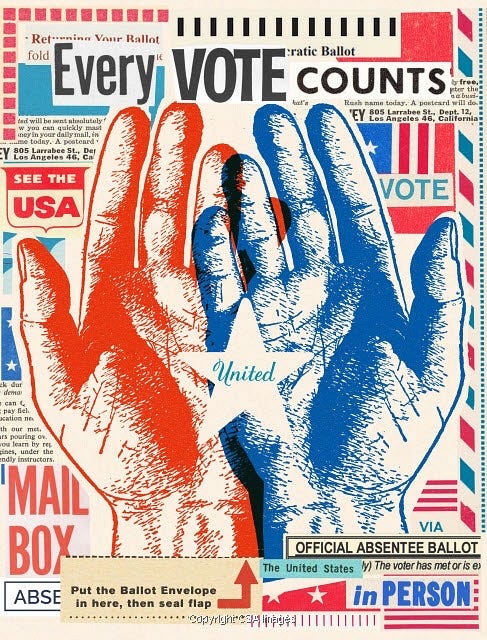
Tomorrow is Election Day.
But tonight I’m thinking about how local modern politics in Hays County has started to resemble fandom.
Fandom.
It’s clear that people attach themselves to political figures the way previous generations attached themselves to celebrities, prophets, or revolutionary icons. Every criticism becomes heresy. Every disagreement becomes betrayal. Every failure must be reframed, defended, mythologized, or blamed on enemies. The individual becomes larger than the actual work itself.
And maybe that’s inevitable in an era where politics increasingly lives online— flattened into personalities, aesthetics, algorithms, and performance.
But it’s dangerous.
Voltairine de Cleyre warned against “the worship of leaders,” arguing that people too often surrender their own judgment in exchange for emotional certainty. Not because they are weak, but because uncertainty is exhausting. It feels safer to believe one exceptional person is fighting for us than to confront the much harder truth:
No one is coming to save us.
Not a county judge.
Not a mayor.
Not a party.
Not a charismatic progressive with a microphone and a social media following.
Real political change has always been collective, messy, contradictory, deeply imperfect work. It comes from communities building durable structures together, not from elevating individual personalities into symbols beyond criticism or question.
And I think that’s what has troubled me most this election cycle— what inspired me to say something— much of the conversation stopped being about governance entirely.
Instead of us debating whether a policy could survive legal scrutiny, or if this coalition would actually hold; instead of asking whether this office can materially accomplish what is being promised, or questioning if relationships can be maintained long enough to produce durable outcomes…
The conversation became:
Who feels like the hero?
Who performs resistance most convincingly?
Who has the strongest personal mythology?
Who “fights”?
But fighting is not governance.
Governance is compromise.
It’s procedural patience.
It’s building a consensus quietly behind the scenes.
It’s accepting the limits of your office instead of theatrically pretending they do not exist.
It’s sharing credit.
It’s understanding that sustainable progress is painfully incremental but we must keep going forward.
That kind of work rarely goes viral.
It doesn’t create local celebrities.
It doesn’t generate photo ops.
It doesn’t satisfy the emotional hunger people have for symbolic warriors in frightening times.
But it is often the only thing that actually improves material conditions sustainability.
I understand why people are drawn toward political personalities right now. Truly. We are living through instability, alienation, institutional collapse, economic precarity, ecological anxiety, and profound distrust. People want conviction. They want certainty. They want someone who sounds fearless.
But politics built around personalities instead of principles inevitably corrodes movements from the inside out. Because eventually protecting the image of the leader becomes more important than confronting reality itself. And once that happens, accountability disappears.
Criticism becomes “division.”
Questions become “attacks.”
Dissent becomes “disloyalty.”
And the movement slowly reshapes itself around preserving one person’s symbolic status instead of achieving concrete outcomes for actual people.
That is not liberation.
That is not democracy.
And it certainly is not community power.
Tomorrow, people will vote however they vote.
But beyond this election, I hope we begin rebuilding a local political culture that values critical thought over loyalty tests, collaboration over ego, transparency over mythology, and collective action over political celebrity.
Because democracy cannot survive if we keep turning politicians into identities instead of public servants.
And no matter how progressive the branding may be, personality cults do not become less dangerous simply because they speak the language of activism.
And despite everything I’ve said here — despite my skepticism of political celebrity, despite my frustration with spectacle politics, despite my belief that no elected official is coming to save us — I still believe deeply in voting.
Because silence is surrender.
Power depends on exhaustion, cynicism, and disengagement. The easiest population to govern is one convinced their voice no longer matters.
Voting is not worship. It is participation.
It is one small way of refusing political apathy and insisting that our communities still belong to the people living in them.
And beyond voting itself, we have to keep using our voices — loudly, critically, imperfectly, consistently. We have to ask hard questions. We have to stay engaged after elections end. We have to resist the temptation to hand our moral and political agency over to charismatic figures and instead reclaim it for ourselves and for each other.
Democracy is not something spectators consume.
It is something ordinary people practice together.
So tomorrow, I hope you vote.
I hope you speak up.
I hope you stay difficult to manipulate.
I hope you refuse cynicism.
And more than anything, I hope you remember that real political power has never lived inside one personality, one office, or one movement figure.
It has always lived inside communities willing to think, organize, question, dissent, and keep showing up anyway.
It’s been fun. Let’s change the future.
xoxo Jenni