


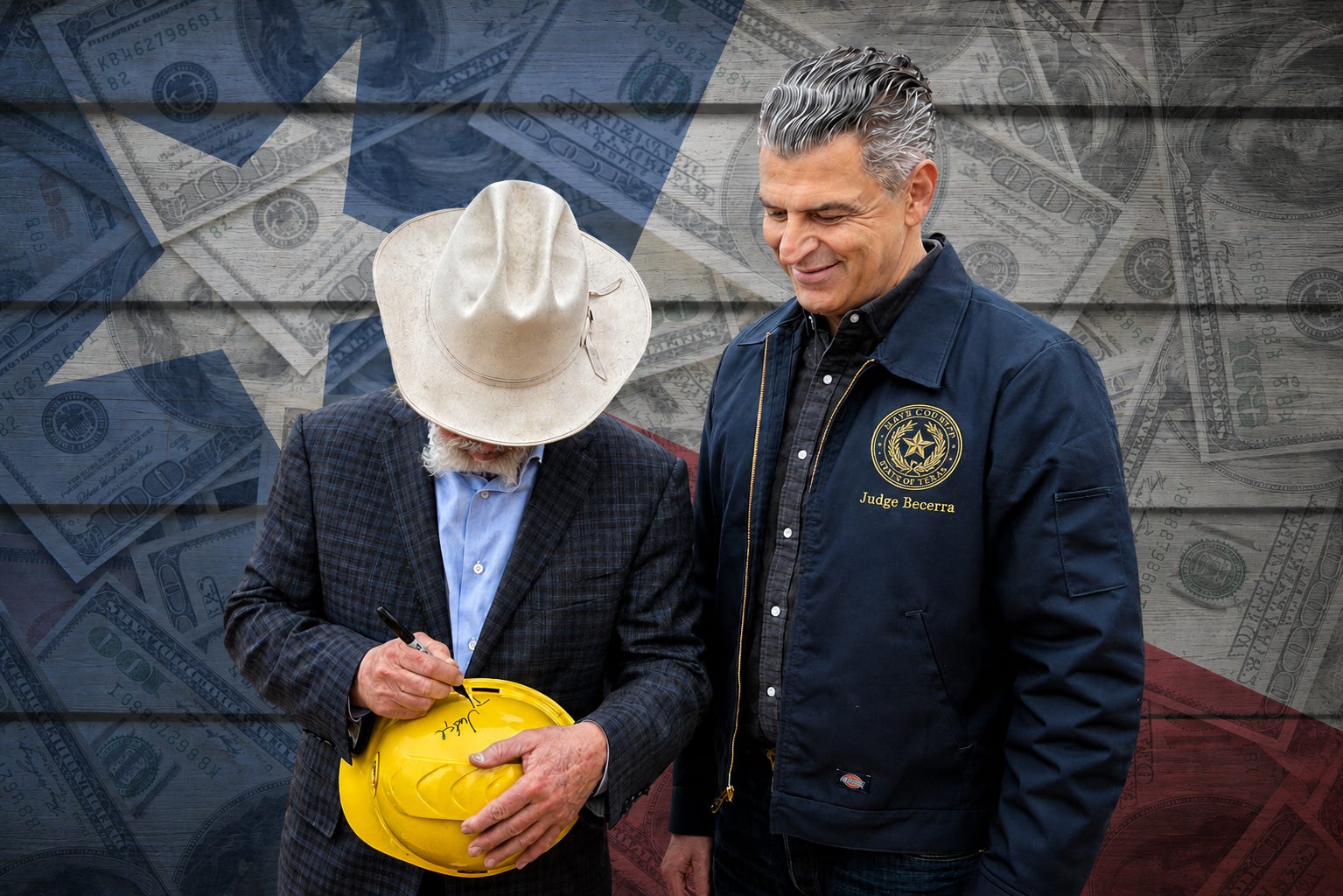
Ruben Becerra says he is the candidate standing up to powerful interests, developers, insiders, & outside influence.
But that’s not quite the story his latest corrected campaign finance report tells.
And I think voters deserve to understand who is actually funding the political brand Ruben Becerra has built.
Special Interest Networks
After reviewing Becerra’s 2026 campaign finance filings, one thing becomes immediately clear:
A substantial amount of his campaign funding comes from outside Hays County.
Contributors come from:
Austin
San Antonio
Houston
Dallas
Brownsville
New Braunfels
Temple
Based on the filings uploaded & reviewed:
roughly $14,000+ appears to come from clearly outside-Hays contributors,
while only about $7,000–8,000 appears clearly local.
That means approximately 65% of the clearly identifiable money in Becerra’s 2026 filings appears to come from outside Hays County, while only about 35% appears clearly local.
That does not include ambiguous border-city addresses like Buda or Dripping Springs, which could push the outside total even higher depending on residency.
Outside money in politics is common.
But it becomes politically relevant when a candidate simultaneously brands themselves as the defender of ordinary locals while their campaign is being funded by outside influence. It becomes hypocritical when he denounces one thing publicly, but files a report right before an election showing something else.
The donor list tells a story
When people hear “outside donations” in a small local county runoff, they often imagine random ideological supporters or one-off contributions from family and friends elsewhere.
That is NOT what these filings show.
Instead, many donors appear connected to:
law firms,
development,
engineering,
consulting,
political infrastructure,
PACs.
That matters because county government decisions directly impact:
growth,
infrastructure,
tax policy,
land use,
development approvals,
municipal contracts,
public-private relationships.
This is not abstract.
Hays County is one of the fastest-growing counties in Texas. Political power here has economic consequences. Donations have influence.
The Linebarger Cluster
One of the most striking patterns is the number of contributors tied to Linebarger Goggan Blair & Sampson, a major Texas law firm that works extensively with governments on delinquent tax collection, court fines, municipal receivables, & local government legal enforcement.
The filings show donations from:
Paul D. Chapa
Richard Haas
Clifton Douglass
The firm itself
Together, these contributions total several thousand dollars.
These are not random neighborhood supporters either.
Linebarger is deeply embedded in the ecosystem of Texas local government. Firms like this work closely with counties, school districts, appraisal districts, municipalities, tax offices, and public finance systems across the state.
Their attorneys & executives are not ordinary grassroots donors disconnected from local politics. Their professional world revolves around governmental relationships.
And that is what makes this particular donor cluster interesting.
Because multiple people connected to a highly networked municipal law firm collectively took an interest in a county-level runoff race outside their home county.
That suggests political alignment, relationship-building, or investment in broader regional influence networks — not random civic participation.
The Developer Money
Several donors are tied to The NRP Group, a major real estate development company.
Contributors include:
Debra Guerrero
Jason Arechiga
Max Whipple
All connected to development or real estate operations.
But politically, donations are rarely random.
And that becomes especially important when you look at the broader controversy surrounding this developer network.
NRP is not just “some apartment company.” It has been tied to some of the most politically controversial redevelopment fights in Texas in recent years.
The company became deeply embroiled in the battle over the proposed redevelopment of Alazán Courts in San Antonio — the city’s oldest public housing complex. The proposal drew fierce backlash from residents, housing advocates, anti-displacement organizers, & preservationists, many of whom argued the redevelopment would accelerate gentrification & reduce deeply affordable housing on the West Side.
The controversy became so intense that the San Antonio Housing Authority ultimately canceled its partnership with NRP after sustained public opposition.
NRP has also been heavily associated with Texas’ controversial Public Facility Corporation (PFC) tax exemption system — a structure critics argued allowed developers to receive massive property tax breaks with insufficient oversight or affordability guarantees.
At one point, reporting indicated NRP was involved in roughly a third of PFC deals in Texas.
The backlash became significant enough that the Texas Legislature eventually reformed the law itself after mounting criticism over:
transparency,
developer windfalls,
reduced tax revenues,
affordability concerns.
Ruben Becerra didn’t do anything illegal by accepting donations from people in this network.
But voters should understand that these are not random apolitical donations from disconnected individuals.
These are people operating inside a highly connected ecosystem of development, municipal politics, public-private partnerships, tax incentive structures, lobbying, & regional growth policy.
And when multiple people tied to those networks begin donating to a county-level runoff race outside their home county, it is fair for voters to ask why.
The political network money
Then there are the openly political contributions.
One filing shows a contribution from:
“TX Friends of Trey Martinez Fischer”
A PAC associated with longtime San Antonio Democratic powerbroker & Texas State Representative Trey Martinez Fischer.
That contribution is important symbolically.
It suggests Becerra is not simply operating as an isolated county official with grassroots support, but as someone plugged into broader statewide political relationships.
Voters should understand the ecosystem in which their local officials operate.
The John S. Davidson mystery
And then there is our friend John S. Davidson. I wrote an article earlier this week about his odd donations.
Across multiple filings, Davidson — a New Braunfels resident — donated repeatedly in rapid succession:
- $1,000
- $1,000
- $1,000
- $250
- $1,200
- $250
- $1,000
- $1,200
- $666 — his latest donation.
for a total approaching $4,000 across the reports reviewed.
The filings alternately list his occupation as:
- “Youtuber,”
- “Not Employed,”
- or leave sections blank.
This is objectively unusual behavior for a county-level donor.
And there’s still the unresolved loan issue
And hanging over all of this is the still-unresolved campaign loan discrepancy.
Earlier filings appeared to show campaign debt totals around the ~$56,000 range.
Later filings now show only ~$20,000 in outstanding loans.
Yet there does not appear to be a clear disclosure trail explaining where roughly ~$40,000+ of that debt went.
The newly amended filing does not appear to resolve that discrepancy either.
That does not automatically mean misconduct.
But transparency matters.
Especially from politicians who build their image around accountability, ethics, & fighting entrenched interests.
The real question
I am not arguing that outside donations are illegal, that developers should never donate, or that political networks are inherently corrupt.
But I am left wondering:
Who is actually funding the political brand Ruben Becerra has built?
Because the answer increasingly does not look like ordinary Hays County residents alone.
It looks like a hybrid coalition of:
regional political actors
legal infrastructure
development interests
consultants
activists
PACs
outside ideological supporters
Voters can decide for themselves whether that aligns with the public image being presented.
But they deserve to see the full picture.
Sources & Further Reading
Campaign Finance Filings
Reporting on The NRP Group & Alazán Courts
San Antonio Heron — NRP Group chosen for Alazán Courts redevelopment
San Antonio Report — SAHA awards Able City contract after ending NRP partnership
Texas Observer — In San Antonio, a Fight over Public Housing Heats Up
Express-News — SAHA walks back plan to redevelop Alazán Courts
San Antonio Conservation Society — Alazán Courts: Change of Plan
Reporting on Texas PFC Tax Exemption Controversies
Express-News — Legislature changes rules on controversial tax breaks used by developers
Texas Legislative Budget Board — Tax Exemptions for Public Facility Corporations
University of Texas School of Law — Public Facility Corporations & Tax Exemptions Report
JD Supra — 2023 Changes to Texas Law on PFC Property Tax Exemptions